
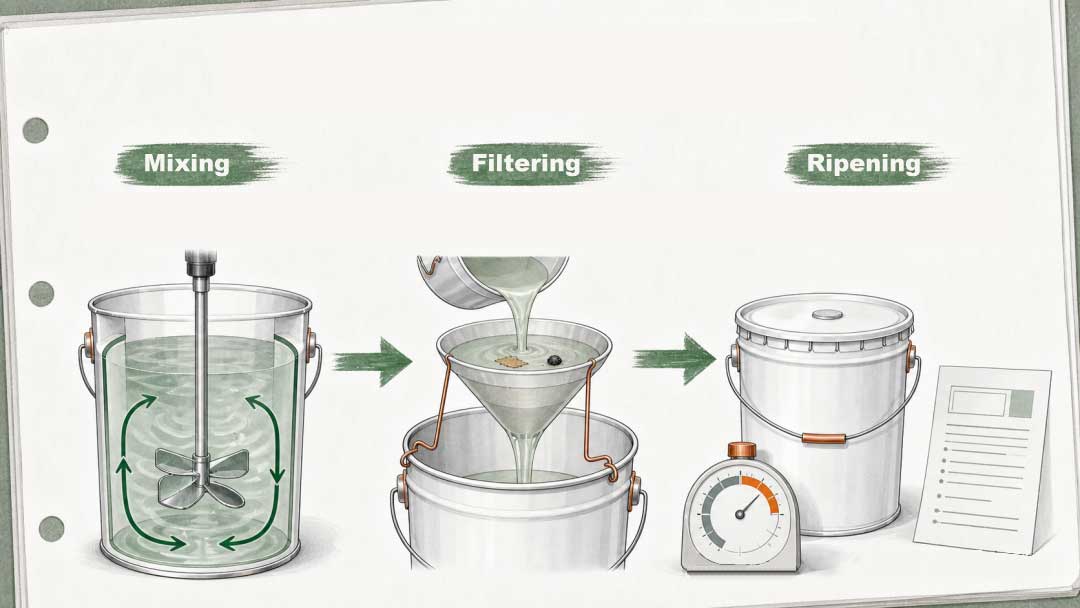
After opening the paint container: stirring, filtering, and induction - three steps addressing three distinct…
Paintshop Key Challenges and Strategies for Wastewater Treatment
Why Is Wastewater from Paintshop Difficult to Treat?
Wastewater from a paint shop is not a single, uniform stream; rather, it is a mixture of several distinct types: pretreatment wastewater (containing phosphorus and zinc), degreasing wastewater (alkaline and oily), paint-booth wastewater (containing paint sludge and solvents), and electrocoating wastewater (containing resins and heavy metals). The composition is complex, concentrations fluctuate, and the pH swings between acidic and alkaline. While individual streams might be manageable, mixing them creates interference – often requiring double the dosage of treatment chemicals, yet still failing to achieve the desired effluent quality.
A further complication is that paint sludge exists as a colloid, making it difficult to settle. Therefore, the first step in designing a wastewater treatment plant is not selecting equipment, but rather identifying the sources and specific characteristics of each wastewater stream.
Key Challenge 1: Lack of Source-Based Segregation
The primary challenge is the practice of mixing all wastewater streams together. In many facilities, all wastewater is directed into a single tank; here, phosphorus from the pretreatment stage interacts with paint sludge, causing the treatment chemicals to interfere with one another. This frequently results in effluent that fails to meet discharge standards for total phosphorus and total nickel.
The solution is to collect and segregate wastewater streams at the source – separating phosphating wastewater, degreasing wastewater, paint-booth circulating water, and electrocoating ultrafiltration concentrate – and subjecting each to specific pretreatment before combining them. Segregation allows for the application of targeted treatment processes, which reduces both chemical consumption and sludge generation. Proper segregation is critical to the success of a wastewater treatment plant and must be incorporated into the piping design phase.
Key Challenge 2: Difficulty in Demulsifying Paint Sludge
Paint in wastewater exists as an emulsion or a colloidal suspension, which cannot be removed through simple sedimentation. It requires demulsification and coagulation: chemicals are added to destabilize the paint particles, causing them to flocculate into larger aggregates that can then settle out, leaving a supernatant that can proceed to biochemical treatment. The choice of demulsifier depends on the type of paint: solvent-based and water-based paints require different agents; using the wrong one prevents flocculation.
Often, when effluent appears turbid, the root cause is incomplete demulsification or the use of inappropriate chemicals. The solution is to conduct bench-scale tests to determine the correct chemicals and dosage ratios. Relying on guesswork or experience alone is ill-advised, as excessive chemical dosing can actually lead to higher COD (Chemical Oxygen Demand) levels.
Key Challenge 3: Sludge Disposal
Coagulation and sedimentation processes generate large volumes of sludge containing paint residues and heavy metals. This material is classified as hazardous waste, making its disposal costly and subject to strict tracking requirements (manifest systems). The core challenge lies not in the generation of sludge, but in its reduction. Strategies include: segregating waste streams at the source to minimize inert sludge; selecting high-efficiency agents for demulsification to reduce sludge yield; and dewatering sludge to a moisture content below 60% to shrink its volume.
Furthermore, repurposing paint sludge (discussed later in the section on hazardous waste) can help lower costs. If sludge volume is not reduced, disposal fees will erode all profits. During the design phase, one must account for both dewatering equipment and hazardous waste disposal pathways – do not focus solely on the cost of water treatment equipment.
Configuring the Process Route
A typical configuration involves: segregated collection → equalization (balancing flow and concentration) → demulsification, coagulation, and sedimentation → biological treatment (anaerobic/aerobic or MBR) to reduce COD → advanced treatment (Fenton oxidation or activated carbon) as a final safeguard → discharge or reuse in compliance with standards. Phosphorus is removed via chemical precipitation, while heavy metals are precipitated as sulfides or hydroxides. Treated water can be reused for rinsing purposes, thereby reducing fresh water consumption. A more expensive process is not necessarily better; the key is to match the technology to the specific water quality. For low-volume or intermittent discharge, equalization capacity must be adjusted to buffer against hydraulic or pollutant shocks.
Operations, Maintenance, and Compliance Management
Effective wastewater treatment relies 70% on proper maintenance. Daily tasks include monitoring influent concentration, pH, and effluent parameters, then adjusting chemical dosages accordingly. Sludge must be regularly removed and dewatered. In biological treatment tanks, the activity of the microbial population must be preserved, with careful management to mitigate temperature or toxicity shocks. Many facilities meet standards upon commissioning but fall out of compliance within six months due to a lack of monitoring, improper chemical dosing, or excessive sludge accumulation.
It is essential to maintain operational logs and install online monitoring systems (for pH, COD, and flow rate) connected to environmental regulatory platforms, ensuring automatic alerts if discharge limits are exceeded. While operational and maintenance costs may exceed the initial equipment investment, they prevent the far greater expenses associated with fines and forced production stoppages.
Practical Engineering: A Four-Step Design Approach
First, characterize the quality and volume of each wastewater stream to develop a segregation strategy.
Second, conduct bench-scale tests to determine the optimal demulsification agents and their dosage ratios.
Third, configure the process route, incorporating sludge dewatering and hazardous waste disposal pathways.
Fourth, install online monitoring systems and connect them to the environmental regulatory platform.
For new facilities, implementing source segregation from the outset saves on long-term chemical and sludge disposal costs; for existing facilities undergoing retrofitting, prioritize the installation of segregation piping before adding new treatment equipment. During the acceptance phase, perform continuous monitoring to assess the system’s resilience against shocks, rather than relying solely on instantaneous compliance checks. Reusing treated wastewater reduces water consumption and offers a quick return on investment.
Common Misconceptions and Corrections
Misconception 1: Mixing all streams into a single tank – this leads to interference and failure to meet discharge standards; streams should be segregated by quality.
Misconception 2: Relying on guesswork for emulsion breaking – this often results in poor flocculation; always conduct bench-scale tests first.
Misconception 3: Accounting only for water treatment equipment while ignoring sludge – sludge disposal is costly; always factor in sludge management.
Misconception 4: Lack of online monitoring – this makes it impossible to detect unauthorized discharges; implement networked, real-time monitoring.
Misconception 5: Intermittent discharge without equalization – this can overwhelm and disrupt biological treatment processes; ensure adequate equalization capacity. Correction: The success of a wastewater treatment plant lies in stream segregation and effective operation and maintenance, not in the sheer quantity of equipment installed.
A practical pitfall to note: Many facilities only install monitoring equipment at the final discharge outlet. If an upstream stream becomes abnormal, it goes unnoticed until the combined effluent exceeds limits—by which time the streams are already mixed. It is advisable to install basic pH and flow meters on individual waste streams to detect and isolate anomalies early. Furthermore, do not use reclaimed water directly in critical production processes; use it first for floor washing or initial rinsing to prevent water quality fluctuations from affecting product quality. If a reuse system incorporates softening or membrane filtration, ensure the feed water is appropriate—for instance, never use turbid reclaimed water for paint spraying, as membrane fouling can lead to months of troubleshooting.
Regarding regulatory standards: Wastewater discharge from coating/painting operations is subject to local and industry-specific standards (e.g., GB 28937 for automotive coating). Parameters such as total phosphorus, total nickel, and total cadmium are strictly controlled, with limits becoming increasingly stringent over time. Design systems with a safety margin rather than designing right at the limit, ensuring compliance even if standards tighten in the future. Ensure alignment between the Environmental Impact Assessment (EIA) and the pollutant discharge permit, and adhere to the monitoring frequency specified in the permit. A thorough understanding of these standards prevents the need for costly rework at the wastewater treatment plant.
One final point: The wastewater treatment plant is intrinsically linked to upstream pretreatment processes and the facility’s drainage network. Adopting methods like silane-based pretreatment (to reduce phosphorus) and segregating waste streams within the drainage network makes the downstream treatment process much more manageable. Many environmental issues stem from a failure to segregate waste streams at the source, allowing paint sludge to enter the wastewater system. Rather than viewing the treatment plant merely as an end-of-pipe facility, consider it the final point of the entire plant’s water system—reducing pollution at the source is the most cost-effective approach. Practical Implementation Points
The primary design principle is “segregated collection”: pre-treat individual waste streams – such as those from phosphating, degreasing, painting, and electrophoresis – separately before combining them; this reduces both chemical consumption and sludge generation. For emulsion breaking, conduct bench-scale tests to determine the optimal chemical dosage; note that solvent-based and water-based systems require different agents – using the wrong one will prevent flocculation.
Implement sludge reduction measures, including dewatering to a moisture content below 60%, ensure hazardous waste is tracked via a manifest system, and explore resource recovery for paint sludge to lower costs. The treatment process should incorporate equalization/homogenization, biological treatment, advanced polishing stages, and water reuse. Install pH meters and flow meters on each waste stream for early anomaly detection, connect online monitoring systems to environmental regulatory platforms, and maintain a safety margin relative to discharge standards to avoid compliance risks.
Summary
The key challenges in a paint-shop wastewater treatment plant stem from three areas: the commingling of waste streams at the source, the difficulty of breaking down paint-laden emulsions, and the high cost of sludge disposal. Segregated collection allows for targeted treatment of each stream, effectively reducing both chemical usage and sludge volume. Bench-scale testing is essential to select the right agents for emulsion breaking, while sludge dewatering and resource recovery help control operational costs. The process flow should integrate equalization, biological treatment, and advanced polishing for water reuse, with operations managed through online monitoring and meticulous record-keeping. Success in wastewater treatment lies in segregated collection and diligent system maintenance, rather than merely accumulating equipment. Minimizing pollution at the source is the most cost-effective approach, and maintaining a safety margin against discharge standards prevents the need for costly rework.

Find More
Comments (0)