
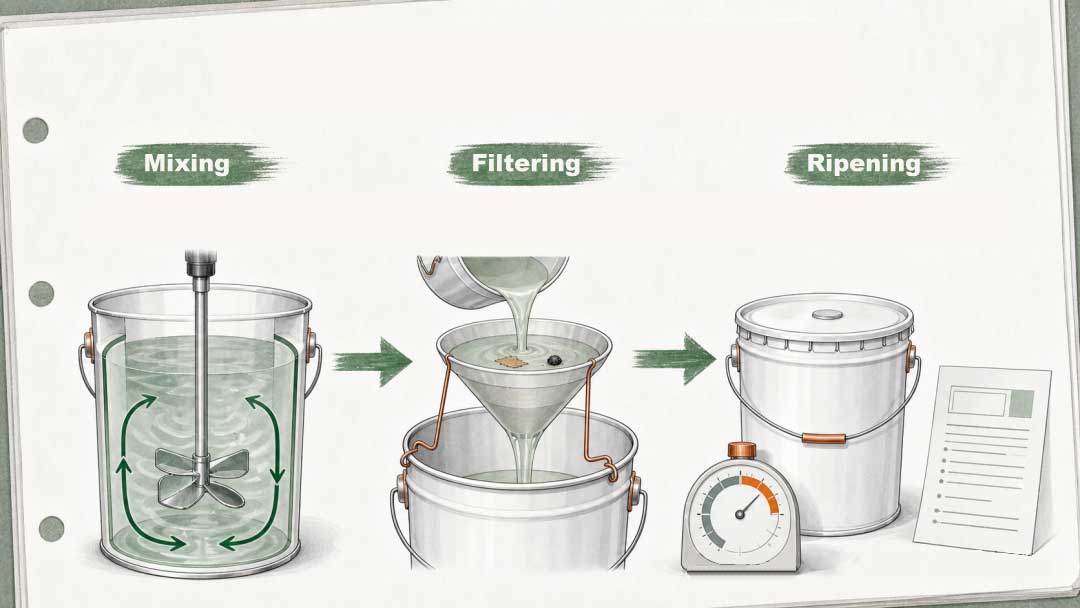
After opening the paint container: stirring, filtering, and induction - three steps addressing three distinct…
PP Plastic Car Bumper Painting Process In-Depth Analysis
For painting of PP (polypropylene) bumpers, the core challenge lies in the extremely low surface energy, high inertness, and solvent resistance of PP material, which makes paint adhesion difficult. Therefore, the process flow revolves around the core issue of “how to effectively activate the PP surface.”
Pre-treatment
This process is crucial to achieving adequate adhesion across the entire product surface and is the most critical step in determining the success of PP painting. The main purpose of pre-treatment is to significantly increase the surface energy of the PP.
Step 1: Pre-cleaning and Inspection
- Purpose: To remove dust, oil stains, and mold release agent residue accumulated during transportation and storage.
- Method: Usually, a neutral or weakly alkaline cleaning agent is used for manual or automatic spray cleaning, followed by rinsing with deionized water and thorough drying. Avoid using strong solvents to prevent corrosion of the PP surface or stress cracking.
Step 2: Surface Activation
This is the most critical step in determining adhesion. Currently, there are two main technologies, and their principles and effects are compared below:
(1) Flame Treatment
High temperature (1000-2800℃) is used to oxidize the surface molecules of the PP, introducing polar groups such as carbonyl and hydroxyl groups. The treatment time is very short (usually 1-3 seconds). After treatment, the surface energy increases from 29-30 mN/m to over 45 mN/m. Advantages: Simple equipment, lower cost. Limitations: Uneven effect, prone to under- or over-treatment (ablation); risk of thermal deformation and fire; not environmentally friendly.
(2) Atmospheric/Low-Pressure Plasma Treatment
Ionized gas generates high-energy particles, which perform nano-scale physical bombardment etching and chemical modification on the surface, improving adhesion through a dual effect. Low-temperature treatment (40-80℃), no thermal damage. Surface energy can be stably increased to 60-72 mN/m. The effect is uniform, controllable, and repeatable. Advantages: Optimal effect, especially suitable for complex three-dimensional shapes (such as bumpers); safe and environmentally friendly; the preferred choice for advanced production lines. Limitations: Higher equipment investment. Step 3: Cleanliness and Timeliness Check
Step3: Cleanliness test
After activation, the “water film test” is commonly used: deionized water is sprayed onto the surface, and it is observed whether the water film is continuous and without breaks (the lotus leaf effect disappears). If a continuous water film is formed, it indicates that the surface energy has met the requirements. Timeliness control: The activated surface exhibits a “reactivity decay” phenomenon. Primer spraying must be completed within 2-8 hours after treatment; otherwise, the treatment needs to be repeated.
Designing a Coating System Suitable for PP Plastic
1. PP Primer/PP Treatment Agent
Contains adhesion promoters such as chlorinated polypropylene, which can form strong penetration and anchoring with the PP surface. The recommended film thickness range is 15-25 micrometers. Too thin will result in insufficient adhesion, and too thick may lead to high internal stress. After spraying, it needs to be fully flash-dried (8-15 minutes at room temperature), and then pre-baked (baked at 50-60℃ for 3-5 minutes) to enhance adhesion.
2. Primer Sanding
Water-based sandpaper or dry sanding paper (P-grade sandpaper) must be used. Defect repair/overall sanding: Usually starting from P400-P600 to eliminate obvious defects.
- Surface fine sanding: Subsequently, P800-P1000 is used for fine sanding to eliminate scratches from the previous sandpaper and obtain a uniform and delicate matte surface.
- Thorough cleaning: Use a high-pressure air gun and a sticky dust cloth to thoroughly remove all sanding dust. This is crucial to prevent particles from appearing in the topcoat.
- Final degreasing: Before spraying the color paint, quickly wipe with a plastic-specific cleaner/degreaser to remove fingerprints and oil film, and immediately wipe dry with a clean cloth.
3. Color Paint Layer
Adds color to the product surface. Key parameters: Recommended film thickness range is 10-20 micrometers, with sufficient flash drying (5-10 minutes at room temperature).
4. Clear Coat Layer
Purpose: To protect the color paint. Two-component polyurethane clear coat is commonly used. Recommended film thickness range is 30-45 micrometers.
Curing
The heat distortion temperature of PP is approximately 100-110℃, but its long-term heat resistance is 80-90℃. Curing must strictly adhere to the temperature limit while ensuring the coating reaction. The conventional curing window is: 70-85°C, baking for 25-40 minutes. A hot air circulation oven must be used to ensure uniform temperature and avoid local overheating. It is recommended to use a furnace temperature meter to check the temperature before spraying to ensure it meets the production process requirements.
Precautions
- Adhesion is critical: Before mass production, a cross-hatch adhesion test (grid test) must be performed. A rating of 0-1 is considered acceptable.
- Process verification: When changing paint batches or PP material grades, a complete process verification must be performed again.
- Quality key: More than 90% of PP coating problems (paint peeling, blistering) stem from insufficient pre-treatment.

Find More
Comments (0)