
Water Transfer Printing (WTP) is an advanced surface decoration technology that transfers patterns from a…
Automatic Spray Painting Line for Christmas Ball
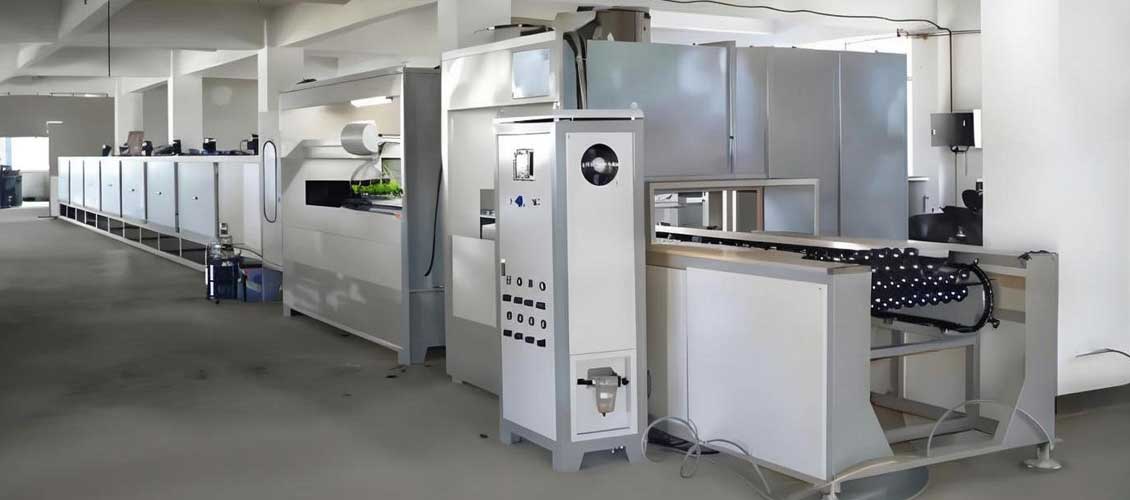
Christmas ball spray painting line overview
A rod loaded with multiple balls on chain conveyor by automatic spraying, then dry up in accurate temperature oven. Operator only need to handle product load/unload then the painting job will be done automatically on conveyor system. Painting line is not dedicated to christmas ball but also compatible with other small products for same workflow requirement.
General workflow for painting line: load -> manual de-dust -> pre-heat -> electrostatic de-dust -> spray base painting -> drying -> vacuum plating -> spray top painting -> drying -> unload
There’re different paints used for christmas ball painting, above flow is used for metal effect purpose and best for uv coating. If no uv required, just regular painting will work. The spraying line can be custom designed according to client side requirement.
Preparation Before Christmas Ball Spray Painting
Christmas Ball Material Analysis
Common Christmas ball materials include plastic (such as PS, ABS, etc.), glass, and metal. The pre-treatment methods and coatings used differ depending on the material. For example, plastic Christmas balls have low surface energy and require surface treatment to improve paint adhesion. Glass Christmas balls have a smooth surface but are fragile, requiring extra care during handling and painting. Metal Christmas balls require pre-treatment such as rust removal and phosphating to prevent rust and ensure coating quality.
Surface Cleaning
Regardless of the material, all Christmas balls need thorough cleaning before painting to remove dust, oil, fingerprints, and other impurities from the surface. For plastic Christmas balls, a special plastic cleaner can be used, followed by rinsing with clean water and drying; glass Christmas balls can be wiped with a glass cleaner and a soft cloth; metal Christmas balls can be cleaned with a solvent-based cleaner to remove oil and rust.
Christmas Ball Spray Painting Process Flow
Pre-treatment
- Plastic Christmas Balls: In addition to cleaning, surface roughening treatment can be performed, such as sandblasting or chemical etching, to increase surface roughness and improve paint adhesion. Flame treatment or corona treatment can also be used to change the molecular structure of the plastic surface and enhance its surface energy.
- Glass Christmas Balls: Generally, no special surface treatment is required, but acid pickling can be performed to remove surface impurities and oxide layers, improving coating adhesion. After acid pickling, rinse thoroughly with clean water and dry.
- Metal Christmas Balls: First, perform rust removal, which can be done using mechanical methods (such as sandblasting, grinding) or chemical methods (such as acid pickling). Then, perform phosphating treatment to form a phosphating film on the metal surface, improving the corrosion resistance and adhesion of the coating. After phosphating, rinse with water and dry.
Primer Application
The primer enhances the adhesion between the coating and the Christmas ball surface, while also providing some anti-corrosion and filling effects. Select the appropriate primer based on the material of the Christmas ornament. For example, plastic Christmas ornaments can use plastic-specific primer, glass Christmas ornaments can use glass-specific primer, and metal Christmas ornaments can use epoxy primer or phosphating primer.
When applying the primer, pay attention to the uniformity of the spray to avoid defects such as sagging and peeling. Generally, an air spray gun or electrostatic spray gun is used for spraying, and the spray thickness should be controlled according to the requirements of the paint.
Topcoat Spraying
The topcoat is crucial in determining the appearance quality of the Christmas ornament. Choose a paint with bright colors, high gloss, and good weather resistance. Common topcoats include acrylic paint and polyurethane paint.
When spraying the topcoat, pay attention to the environmental conditions, such as temperature and humidity. Too high or too low temperatures, or excessive humidity, will affect the quality of the coating. Spraying should generally be carried out in an environment with suitable temperature and low humidity. At the same time, control the spraying pressure and distance to ensure that the topcoat is sprayed evenly and smoothly, without orange peel or pinhole defects.
Decorative Spraying (Optional)
If you need to add some special decorative effects to the Christmas ornament, such as patterns or designs, you can perform decorative spraying after the topcoat is applied. Screen printing, pad printing, or airbrushing can be used for decoration.
For example, when using screen printing, a screen printing plate must be prepared first, and then the paint is printed onto the surface of the Christmas ornament through the screen printing plate to form the desired pattern or design. Pad printing uses a pad printing head to transfer the pattern from the printing plate to the surface of the Christmas ornament. Airbrushing uses an airbrush machine to spray the pattern directly onto the Christmas ornament.
Curing Treatment
After spraying is completed, the coating needs to be cured to allow the paint to fully dry and harden, achieving the required performance. The curing method and time vary for different types of paint.
For thermoplastic coatings, natural drying or low-temperature baking is generally used; for thermosetting coatings, such as epoxy paint and polyurethane paint, high-temperature baking is required for curing. The baking temperature and time must be strictly controlled according to the requirements of the paint to avoid affecting the coating quality due to excessively high or low temperatures.
Spray painting line drawing
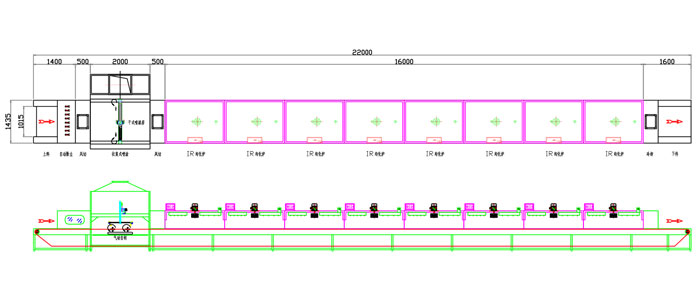
Automatic spray painting line is perfect choice when client requires mass production, however most of the time there’re many different products to be painted for small quantity requirement. If we use the automatic line directly, it’s not economical choice and it’s not compatible with all products painting. Because of this, we provide dedicated 5 axis coating machine for spraying purpose.
Up to 3 rolls can be loaded to machine to spray together, if product is big or quantity is small, you can also spray one roll. Rod will rotate smartly to make sure everywhere can be sprayed properly. After all products are painted, they can put together in a cart to dry up in oven.
Any question? contact us below for professional solutions!

Comments (0)